Expedition History
Alaska to Tierra del Fuego: The Range Rover That Crossed the Americas
How two pre-production Range Rovers, a British Army team and 250 miles of jungle and swamp turned a new 4×4 into a legend.
Published by
Black Decal Project
Filed under
Land Rover Heritage
Reading time
6 minutes
In 1972, two brand-new Range Rovers set out to drive the length of the Americas, and the hardest 250 miles were in the middle.
The British Trans-Americas Expedition took two pre-production Range Rovers, a British Army team and a very reluctant jungle from Alaska to the tip of South America. It did not make the first vehicle crossing of the Darién Gap — a Land Rover had done that a dozen years earlier — but it was a landmark test that turned a car launched only in 1970 into an overland legend.
At a glance
The expedition
British Trans-Americas Expedition, from December 1971.
The Gap
About 99 days across 250 miles of jungle and swamp.
The catch
Not the first vehicles through the Gap — a Land Rover and a Jeep were, in 1960.
Section 01
A New Car with Something to Prove
The Range Rover had been on sale only since June 1970 when Rover, by then part of Leyland, lent two to an expedition led by Major John Blashford-Snell, an Army explorer, and crewed largely by the 17th/21st Lancers. Rover was counting on the publicity, and prepared the cars accordingly: left-hand-drive Swiss-market specification, with roof racks, bridging ladders, capstan winches, a double front bumper, a single rear seat to make room for stores, and large off-road tyres.
Specification · 1971–72
The British Trans-Americas Expedition
Route and dates
Anchorage, Alaska to Tierra del Fuego, along roughly 17,000–18,000 miles of the Pan-American Highway — December 1971 to mid-1972.
Vehicles
Two pre-production Range Rovers prepared by Rover, plus an older short-wheelbase Land Rover used as a pathfinder in the Darién Gap.
Crew and support
Led by Major John Blashford-Snell. Army officer Gavin Thompson of the 17th/21st Lancers drove the Range Rovers through the Gap, with a team of 64 men drawn mainly from the Royal Engineers, plus scientists studying the flora and fauna.
Milestones
- ▸Claimed as the first vehicle-based north-to-south crossing of the Americas through the Darién Gap in a single trip
- ▸Described by Land Rover Monthly as Land Rover’s first endurance event with full logistical support
- ▸One of the cars, registered VXC 765K, survives in the Dunsfold Collection
Section 02
The Long Road to the Gap
The team was flown to Anchorage in December 1971, in the middle of the Alaskan winter. Early in the journey one Range Rover hit a stationary truck head-on in Canada. Thompson and his crew hauled it on an A-bar to Vancouver, waited a week for parts from England, and had it rebuilt at a local Leyland dealer. It then carried on and completed the expedition.
It took just over a month to claw through the snowy north of Canada, and by January 1972 the team had reached Panama and the edge of the Gap.
Section 03
The Darién Gap: 250 Miles in 99 Days
The Darién Gap is the break in the Pan-American Highway between Yaviza in Panama and Turbo in Colombia. In a straight line that is about 106 km, but the expedition’s route through rainforest, rivers and swamp was closer to 250 miles. There were no roads and no bridges, and the Atrato swamp on the Colombian side is flat marshland at least 80 km wide.
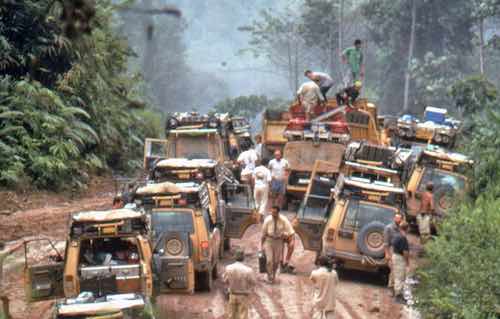
The Range Rovers entered the jungle in January 1972. Thompson was the only driver. He would take the first car to the end of the cleared trail, then run back to bring up the second, which was guided on foot by Royal Engineer Michael Cross, while the team cut the trail ahead using winches, rafts and, in the thickest swamp, dynamite.
The vehicles themselves became the problem. Overloaded and fitted with oversized swamp tyres, the Range Rovers broke differential after differential. Thompson flew back to Britain to consult, and Land Rover sent development engineer Geof Miller to Panama to supervise a change of tyres and the removal of much of the kit. The team also picked up an older short-wheelbase Land Rover in Panama to break trail ahead of the Range Rovers.
99
Days in the Gap
250
Miles of route
64
Men on the team
3
Vehicles
“
I tried to drive everywhere I could except into deep water.
Gavin Thompson, expedition driver
Rivers were crossed by raft, and at one point rough currents capsized Thompson in the middle of a channel and nearly submerged the vehicle. It was winched to dry land, repaired, and made a full recovery. The British Army airlifted supplies as the team progressed, and along the way the expedition came across the remains of one of the Corvairs from an earlier attempt.
The final obstacle was the Atrato waterway. The expedition used boats to get across the swamp and emerged in Colombia after about 99 days, then drove on south.
Stage 1
Into the jungle
The road ends. Winches, rafts and trail-cutting replace driving.
Stage 2
The diffs fail
Weight and oversized swamp tyres break differentials, again and again.
Stage 3
A new approach
Tyres changed, kit stripped out, and an old Land Rover breaks trail.
Stage 4
Out via the Atrato
The waterway carries the team out, and the Range Rovers drive on.
Reading the record
Was it really the first?
A common claim is that the Range Rovers made the first vehicle crossing of the Darién Gap. They did not. The Trans-Darién Expedition of 1959–60, a Land Rover Series II 88 named La Cucaracha Cariñosa and a Jeep, left Chepo, Panama, on 2 February 1960 and reached Quibdó, Colombia, on 17 June 1960, after 136 days. Land Rover Monthly says Rover was happy to let the “first” claim stand at the time.
What the 1972 expedition can fairly claim is the first north-to-south crossing of the Americas by land vehicle in a single trip through the Gap, with two caveats: it used boats to bypass the Atrato swamp, and it had substantial British Army support.
Section 05
South to the End of the Road
With the Gap behind them, the Range Rovers carried on through South America to the southern tip of the continent in 1972. Sources disagree on how long the whole journey took, from about six months to eight.
Land Rover’s own heritage account says the expedition dramatically raised the Range Rover’s reputation for durability and off-road ability, and the company followed up with further challenges of its own. The car that crashed in Canada, VXC 765K, was rebuilt by Land Rover after the expedition, restored again in 1994, and now sits in the Dunsfold Collection. A Darién Gap Range Rover also made its US debut at Pebble Beach in August 2025.
Further reading
- ▸The Hundred Days of Darién, Russell Braddon (1974)
- ▸Making the Range Rover Legend: The 1971–72 British Trans-Americas Expedition, John Carroll — called the best book on the expedition by Land Rover Monthly
Black Decal Project
Final Thoughts
Whatever the record books say about who was first, the 1972 expedition proved that a car on sale for less than two years could go where almost nothing else would: through the middle of the Darién Gap and on to the end of the road.
The road ended. The Range Rover didn’t.