Rally-Raid History
The Dakar: A Short History of the World’s Toughest Rally
From a wrong turn in the Ténéré to the dunes of Saudi Arabia — how the Dakar began, and how Land Rover and Toyota have shaped its story.
Published by
Black Decal Project
Filed under
Motorsport History
Reading time
6 minutes
Bikes, cars, trucks, side-by-sides and classics all start the Dakar with the same question hanging over them: can you find your way, and will your machine survive the answer?
The 2026 edition ran from 3 to 17 January in Saudi Arabia as the opening round of the World Rally-Raid Championship, with 812 competitors from 69 nations, support crews included. It was also the year Land Rover’s Defender arrived and won its class at the first attempt — a result with deep roots, because Land Rover and Toyota have both been part of this rally since its very first edition.
At a glance
The start
Paris, 26 December 1978 — 182 vehicles bound for Dakar.
The marques
Range Rover and Toyota were both on the grid for the first edition.
2026
Dacia won overall; Defender won the new Stock class on debut.
Section 01
How the Dakar Began
Thierry Sabine lost his way in the Ténéré desert during the Abidjan–Nice rally, and decided the desert deserved a rally of its own.
The first Paris–Dakar left the Place du Trocadéro on Boxing Day 1978 with 182 vehicles — 80 cars, 90 motorcycles and 12 trucks — and reached Dakar on 14 January 1979. Only 74 made the finish. Cyril Neveu won on a Yamaha, and the best-placed car was a Range Rover.
Sabine died in a helicopter crash in January 1986, but the rally he founded kept growing, and changed continents twice.
1979–2007
Europe & Africa
Mostly Paris to Dakar; from 1992 some editions started elsewhere or finished elsewhere, but kept the name.
2008
Cancelled
Security threats in Mauritania led to the cancellation of the rally.
2009–2019
South America
Eleven editions run across the continent.
2020–today
Saudi Arabia
The first time the Dakar was held in Asia.
“
A challenge for those who go.
Thierry Sabine, founder of the Dakar
Section 02
Land Rover: There From Day One
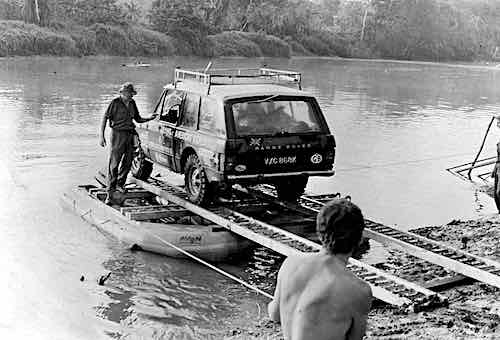
Range Rovers were on the grid in 1979, and one of them — Alain Génestier, Joseph Terbiaut and Jean Lemordant’s V8 — was the best-placed car, fourth overall behind three motorcycles. Land Rovers were entered too.
Two years later, René Metge and Bernard Giroux won the 1981 car class in a Range Rover V8, and Range Rovers kept turning up in the results through the early 1980s.
The latest chapter began in 2025, when Defender became the Dakar’s official vehicle partner, with specially prepared Defenders used by the organisers to plan the routes for the 2026, 2027 and 2028 events.
1979
Best-placed car
A Range Rover V8 driven by Génestier, Terbiaut and Lemordant finishes fourth overall, behind three motorcycles.
1981
Car-class win
René Metge and Bernard Giroux win in a Range Rover V8.
2025
Official partner
Defender becomes the Dakar’s official vehicle partner, with a deal running through 2028.
2026
Stock class win
Defender Rally wins the new Stock class on debut, finishing first, second and fourth.
Section 03
Toyota: Reliability Under Pressure
Toyota was there in 1979 too. The first entry list is full of Toyota BJ and FJ40 Land Cruisers, among them one entered by the founder, Thierry Sabine.
The outright win took longer. Toyota Gazoo Racing South Africa has run the Hilux at the Dakar since 2012, and after finishing second in 2018, Nasser Al-Attiyah and Mathieu Baumel gave Toyota its first overall victory in 2019. Hilux wins followed in 2022 and 2023, and in 2025 for Overdrive Racing’s Yazeed Al-Rajhi.
2019
Nasser Al-Attiyah / Mathieu Baumel
Toyota Gazoo Racing — Toyota’s first overall win
2022
Nasser Al-Attiyah / Mathieu Baumel
Toyota Gazoo Racing
2023
Nasser Al-Attiyah / Mathieu Baumel
Toyota Gazoo Racing
2025
Yazeed Al-Rajhi / Timo Gottschalk
Overdrive Racing
Away from the headlines, Toyota-powered teams have owned whole classes. Team Land Cruiser Toyota Auto Body won the production category six years running to 2019, and Hino Team Sugawara took its truck class for a tenth straight year. In recent years, Toyota’s Land Cruiser has also been the benchmark in the production-based Stock class.
Section 04
Dakar 2026: Defender’s Debut
Defender Rally entered three Defender Dakar D7X-R cars in the new Stock class, which is reserved for production-based vehicles. The D7X-R is derived from the Defender OCTA and keeps its D7x body architecture, transmission and driveline layout, along with the 4.4-litre twin-turbo V8. The changes include modified suspension, fuel and cooling systems.
Rokas Baciuška and Oriol Vidal won the Stock class. Sara Price and Sean Berriman were second, and Stéphane Peterhansel — a 14-time Dakar winner — finished fourth with Michaël Metge. The team also took a Stock-class 1-2-3 on Stage 2, and Defender says the winning car finished with only cosmetic damage.
Reading the result
A class win, not an outright win
Stock is a separate class for production-based cars. Outright victory in 2026 went to Nasser Al-Attiyah’s Dacia, his sixth Dakar win, with Ford second and third.
Toyota’s all-new DKR GR Hilux started fast: Hiluxes took the top five places on Stage 2, with Seth Quintero winning, and Henk Lategan led the rally after winning Stage 4. But form fluctuated, and a broken wheel nut on Stage 11 cost Lategan more than four hours. Saood Variawa and customer driver Eryk Goczal also won stages, and Toby Price was the best Toyota in eighth.
Section 05
For Every Contender
The Dakar is not only for the front-running cars. The 2026 event produced a winner in eight categories:
Bikes
Luciano Benavides
Red Bull KTM Factory Racing
Cars
Nasser Al-Attiyah / Fabian Lurquin
Dacia Sandriders
Stock
Rokas Baciuška / Oriol Vidal
Defender Rally
Challenger
Pau Navarro / Jan Rosa
BBR Motorsport
SSV
Brock Heger / Max Eddy
Trucks
Vaidotas Žala / Paulo Fiuza / Max van Grol
Classics
Karolis Raišys / Christophe Marques
Ovoko Racing
Mission 1000
Jordi Juvanteny / José Luis Criado / Xavier Ribas
KH7-Ecovergy
Section 06
What Comes Next
Defender has said it plans to return to the Dakar in 2027 and 2028, as part of a three-year World Rally-Raid Championship programme in the Stock class. In August it also previewed a road-going Defender Dakar at Monterey Car Week — a limited run derived from the D7X-R, with a twin-turbo 4.4-litre V8 reported at around 626 hp. Reservations are due to open in early 2027.
The 2027 Dakar is scheduled for 1 to 15 January in Saudi Arabia. Whether Toyota’s Hilux and Land Cruiser can answer will be settled, as ever, in the sand.
Black Decal Project
Final Thoughts
Whatever you drive — a factory prototype, a customer Hilux, a production-based Defender or a bike — the Dakar rewards preparation, reliability and nerve.
From the first Range Rover and Land Cruisers on the 1979 start list to the Defender D7X-R of 2026, the story is the same: finish, and the rest follows.